Archive Search Page
100 years on - Honest Dan, the forgotten man?
1854 to 1924
Burnley

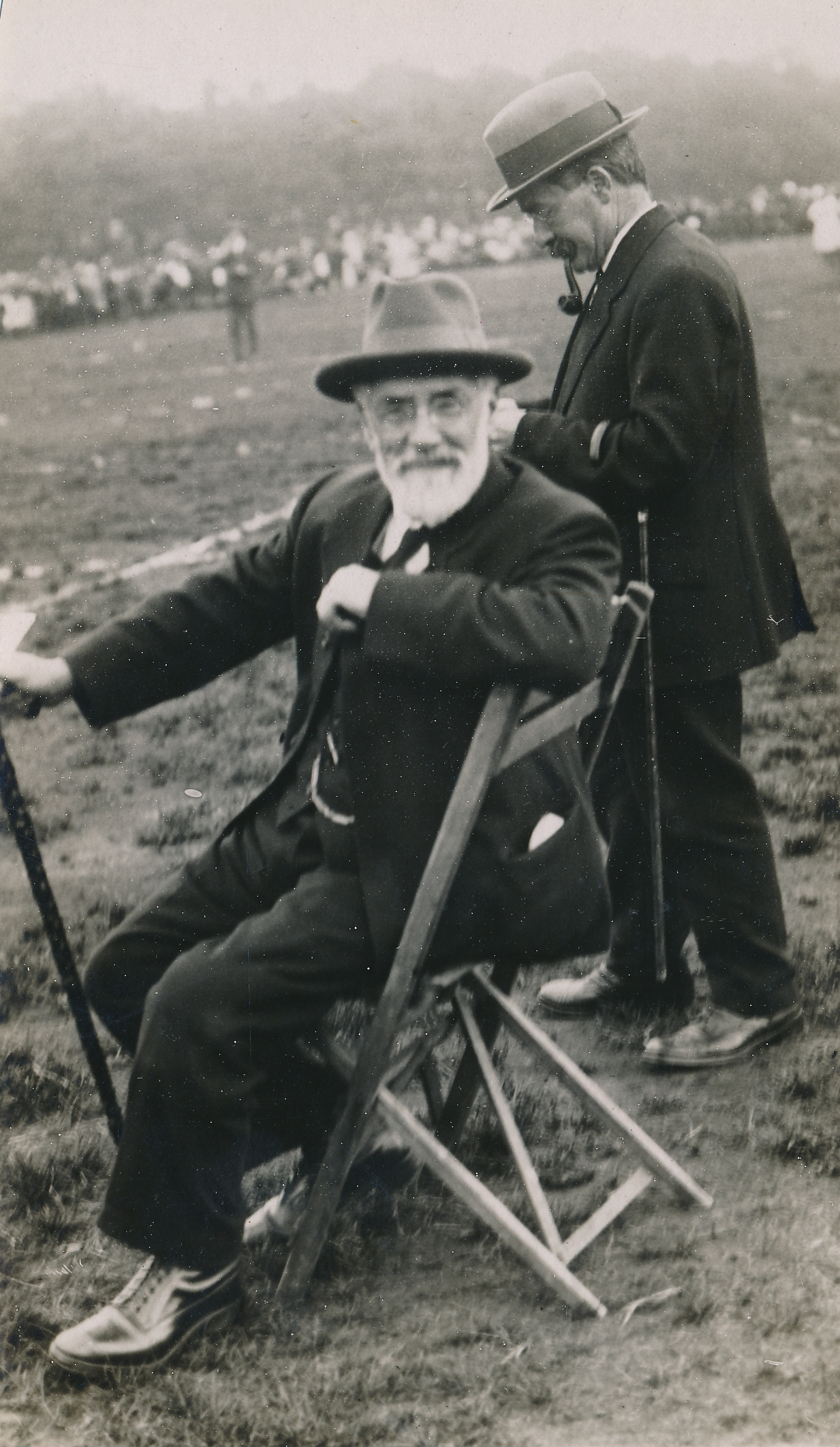
Dan Irving and an unknown companion.
On 25th January 1924, just as a first Labour government was taking office, Burnley’s veteran Labour MP Dan Irving died in his rooms in Clapham. He was 69. Dan may not have changed the course of history but he gave it a bit of a shove. The vacant seat was taken by Arthur Henderson, who became a Nobel peace prize winner.
To mark the centenary of Dan's death, this is a brief summary of his remarkable life, concentrating on the Burnley years, warning - it does not attempt to explain early socialist factions.
So what was Dan Irving like? Born into a family of shop-keepers, in Birmingham, on 31st October 1854, he went to work at 13, spending 8 years in the Merchant Navy, then lived for about 20 years in Bristol, and finally 30 years in Burnley. So his accent may have been interesting. He was an avid auto-didact, intelligent and knowledgable, not just about politics. He liked poetry, was a long time friend of the writer Ethel Carnie Holdsworth, and had friends of all political views.
He could be impatient, and have a hectoring, belligerent manner in public, but as Roger Smalley says in his excellent 2021 biography, privately “Dan had a name for being warm-hearted and considerate with a keen sense of humour”.
In September 1884, at work in the shunting yard of the Midland Railway, his right leg was crushed by a wagon, and had to be amputated, and he lost his job. By then Dan had a wife, Clara, who herself suffered from chronic poor health, and two daughters, Ethel, b 1880, and Edith, b. 1882. The Railway took him back on in a clerical job, but only paid him less than half his previous wage. In his years in Bristol he went from being a Liberal Baptist, to a non-believing, left wing member of the Socialist Democratic Federation (SDF). He became heavily involved in trade union organisation and a leading campaigner for socialism, in Bristol and beyond. He was said to be a rousing speaker, at his best outdoors, and able to make people laugh.
The Burnley Years
In mid 1892, the Irvings had moved to Starnthwaite near Kendal. Dan was to help run a Home Colony, intended to offer the unemployed the chance to live off the land as an alternative to the workhouse. The scheme, funded by philanthropists, was managed by a socialist cleric, Revd. Mills. However, within a year, after a bitter dispute with the Revd. Mills, the colonists were forcibly evicted. Friends gave the Irvings a home locally, but in the summer of 1893, they were practically destitute. Disabled as he was, Dan earned what he could as an itinerant speaker on socialism, but it was demanding work with constant travelling, and his health was suffering. In early 1894, the thriving SDF branch in Burnley took him on as their branch secretary. So the Irvings came to Burnley, and never left. In the 1901 census they were living at 31 Williams Road. In later years they moved to 80 Glen View Road.
Although only a small number of men could vote in General Elections, everyone, even women, could vote, and stand, in municipal elections, so if socialists like Dan were to have any influence, they needed to get elected onto the town Council and bodies such as the Board of Guardians, and the School Board. So Dan put his socialist agenda to the Burnley electorate. It took some time but in 1897 he was elected to the Burnley School Board, next he became an elective Borough Auditor. In 1901 he was elected to the Board of Poor Law Guardians, and in 1902 to the town council. By the time he’d finished, there was hardly a Council Committee that Dan hadn’t sat on.
Education however was his priority. Dan believed “a good education was that which gave to the body and to the soul all the beauty and all the perfection of which they were capable.” He campaigned nationally for the school leaving age to be 16, arguing that child labour was immoral, gave employers a pool of cheap labour to exploit, and depressed adult wages.
The socialist/labour elected representatives were few but Dan made two very important Liberal allies in Dr. Sinclair, who had come to Burnley from Scotland in 1890 as surgeon at the new Burnley Victoria Hospital, and Lady O’Hagan, of Towneley Hall. The Burnley School Board, often reluctantly, became known as one of the most progressive in the country for measures including:
• All teachers in all schools should be qualified, and paid accordingly
• Girls should have the same educational opportunities as boys with higher education open to all
• A School Medical Officer was appointed to care for the children, but particularly the “mentally and physically defective”, deaf or blind, (the Burnley Tradesmen’s Association protested this extravagance to the rate payer.)
• Special schools for the deaf and blind children, fresh air school for the sick children to get them healthy and a school clinic for dental care.
Lady O’Hagan died in 1921, much mourned. The “aristocrat and the democrat” had been unlikely friends and colleagues on the School Board for 25 years. Dan said that when he came to Burnley at first he was very unpopular, but she had not been afraid to be seen walking with him, when “unpleasant things” could happen to people who did that and “her courage had won his heart.”
Dan also worked tirelessly for the greater socialist/labour cause, and in particular, supported Henry Hyndman, the SDF party leader, in his four unsuccessful efforts to get elected as M.P. for Burnley. Hyndman recalled going up Manchester Road and looking down on Burnley in the 1890s and seeing an infernal pit “of carbon-laden fog and smoke, and human degradation”.
By the December 1918 election, when all men over 21 and some women over 30 had the vote, “Honest Dan” had become a local institution and he was elected Burnley’s first Socialist/Labour M.P. He was re-elected in November 1922 and December 1923. He went back to Westminster in January 1924, became unwell with pneumonia and Clara was sent for. He had survived bouts of serious illness before, and his death from a heart attack on 25th January 1924 was a huge shock.
The funeral
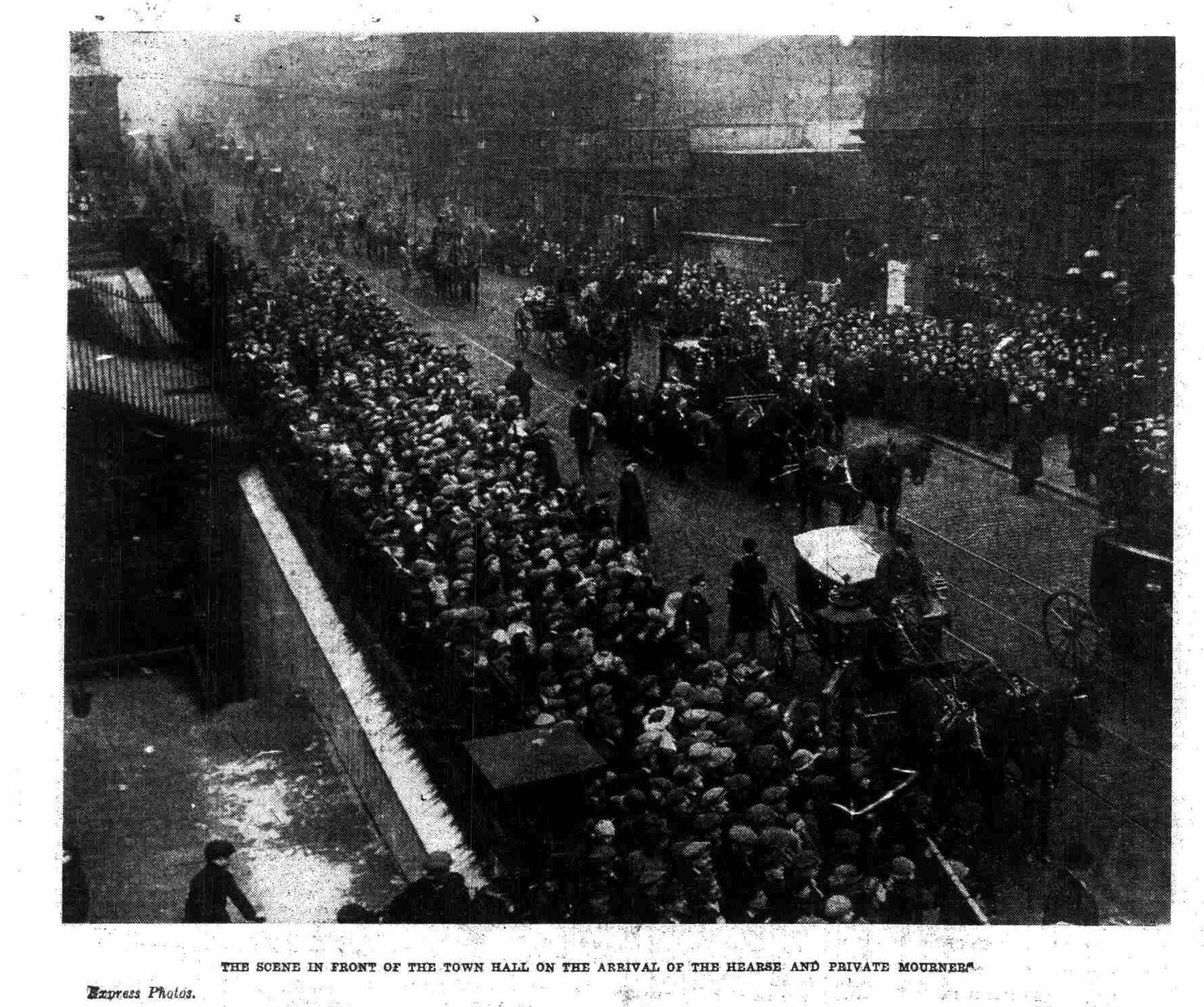
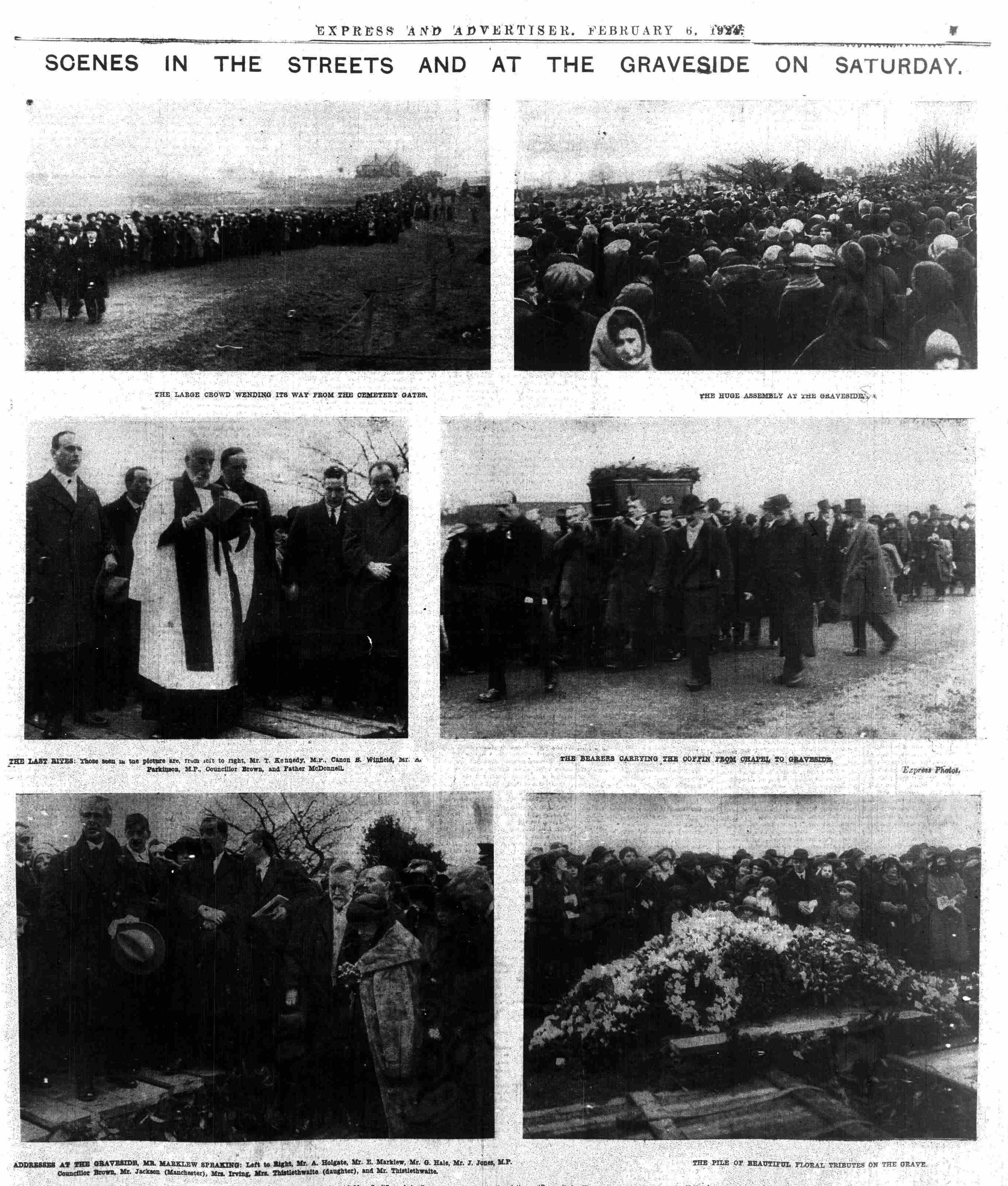
It is not possible to do justice here to the outpouring of grief which followed his death, and the magnitude of his public funeral on Saturday 2nd February 1924. Clara hated being in the public eye and this must have been a dreadful ordeal, added to the pain of losing her husband of over 40 years.
On 6th February 1924 the Burnley Express and the Burnley News dedicated several pages to the funeral, with photos. The cortege with family and friends was joined at Burnley Town Hall by representatives of civic authorities and public bodies in vehicles, three landaus with flowers, the Municipal Brass Band, and representatives of socialist organisations and trade unions carrying their banners, who followed on foot. Sad crowds lined the route all the way to the Cemetery. Weavers had been allowed to finish work early at 10 a.m. that Saturday to attend. Businesses were closed for the duration of the procession. Amongst the messages of condolence was one from the Governor of Gibraltar, General Munro and his wife Mary, daughter of Dan’s great old ally, Lady O’Hagan.
So why is this remarkable man, who worked so hard for the socialist/labour cause, not as well known as others from that time? Perhaps because he concentrated on trying to make life better in the here and now for the people of this one northern industrial town?
(admin/LG Education)