Courtiers Of A Destroyed Monarchy (1 of 9)
22 October 1968
John Spencer (Burnley) Ltd
Media Ref: BE68ng41170
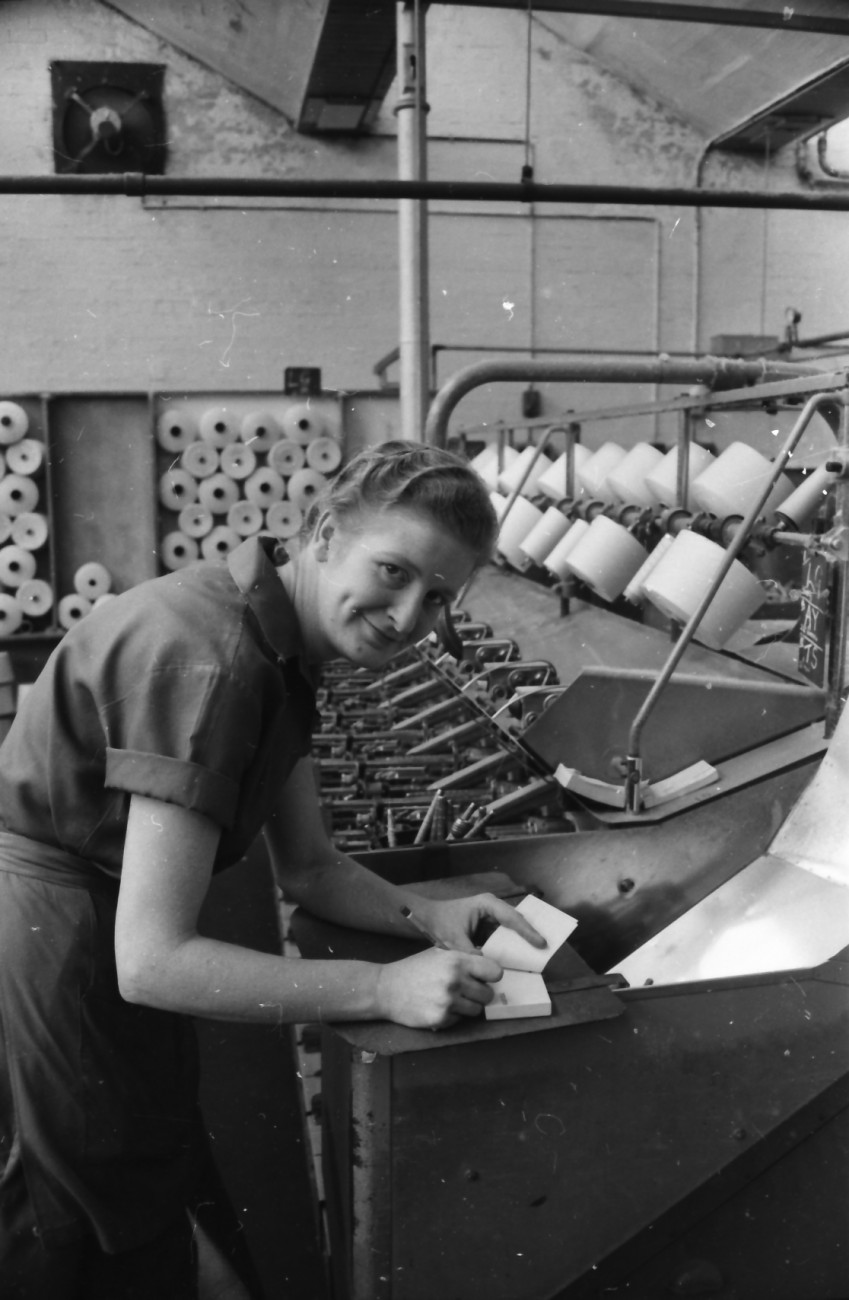






"I wouldn't like to do any other job." says cone winder Mrs Doreen Parker. King Cotton has fallen from his throne, but his is the only court some of our Lancashire people have ever known. They will go to their graves worshipping at the crumbling shrine. We have heard the voice of the textile industrialists, the voice of the Government, the voice of the trade unionists. They all know why the industry has shrunk over the decades. They pass the buck to each other, but the industry goes on shrivelling.
In Lancashire we have simply not kept pace with modern methods of industrialisation. Obsolete machinery and methods were replaced too late to keep the world market, once our monopoly.
I met four youngsters in the canteen at John Spencer (Burnley) Ltd, Imperia Mill. They were having a breakfast break on the early morning shift. David Lord (18) a roller carrier had got the job through an advertisement in a newspaper. David Hargreaves (20), a knotting machine operator (twister to you) said “It’s hard to tell if there is any future in cotton, but this mill is good, I like it here.�
Quite a few women now work as clothlookers, once a preserve of men. Mrs Shirley Lyons (27) remarked “ It pays better money than most jobs for women.� A group of automatic weavers, all women, would not put their children into the industry if they could help it, as it was viewed as a dying industry. Some of the women started life on the Lancashire looms, but preferred automation.
On piece rates, the average weaver earns £15 per week, which isn’t much for a skilled job these days. Employers tend to take on boys rather than girls, because boys are allowed to work on night shifts and therefore girls are restricted in multi-shift establishments. Traditionally, women were better weavers than men, but never aspired to be overlookers. Promotion is still restricted, even though the textile industry recognises equal pay for men and women, long before most industries had thought about it.
In one way, it’s a good job that Lancashire no longer depends entirely on one industry, but if that industry is not the “backbone� of England, and once it was, whose to blame? Smug with the world market, we forgot to look ahead, and in forgetting, toppled King Cotton. Monarchy once destroyed, seldom sits on a throne again.