Bulldozed! Days of Reeking Hovels (1 of 2)
17 Jul 1970
Salford Street, Burnley
Media Ref: BE70ng45384
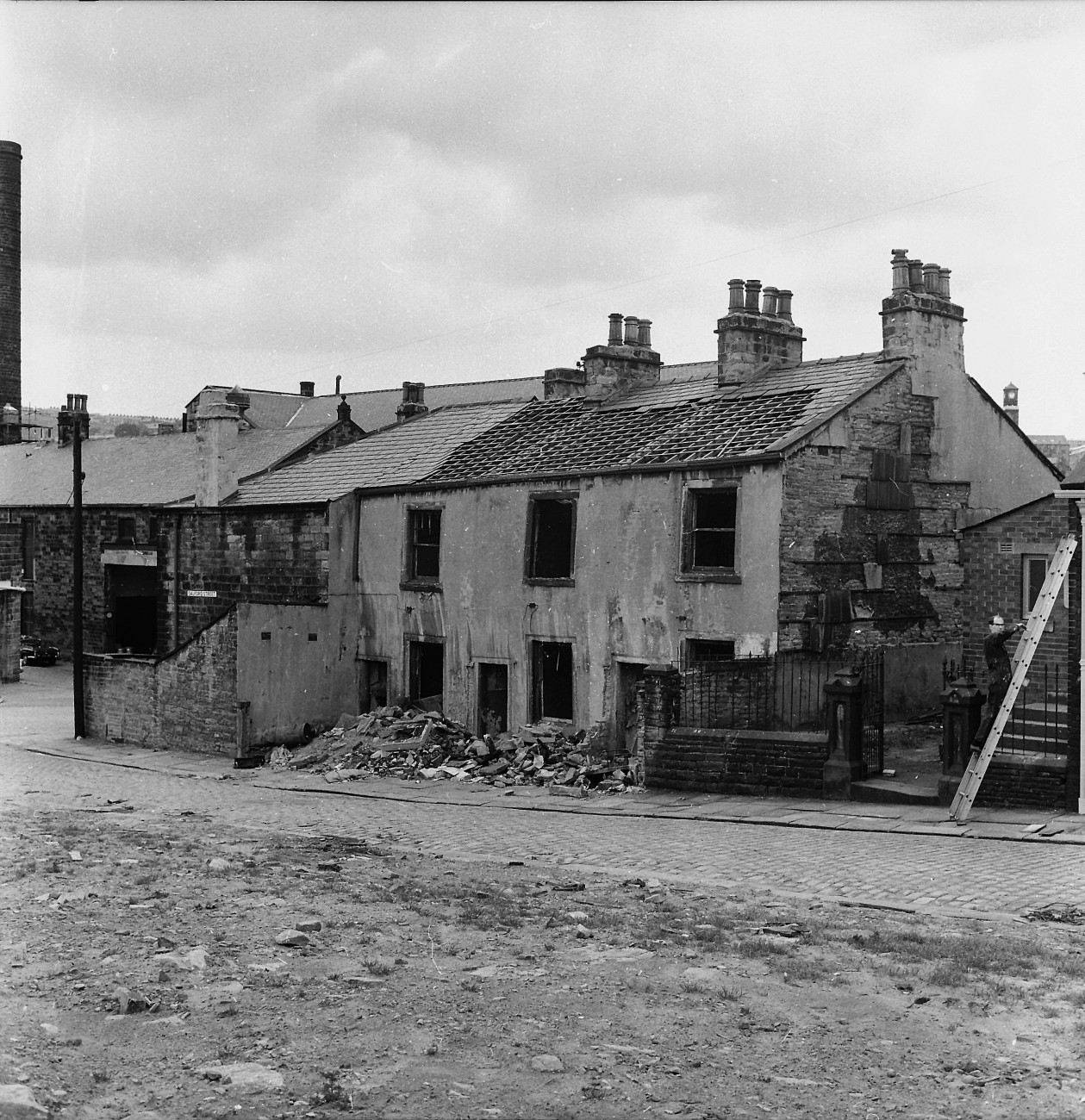

Look twice at this picture of houses being demolished - for it is Salford Street which you will never see again. In the past few days it has gone, and with it an era could be said to have died. There will be few tears at the passing, for its name stood for a district which for many years represented the worst of Burnley life. Poverty made Salford district a by-word for drunkenness and violence. Police were compelled to patrol it in pairs, and kept out, whenever they could, to avoid trouble.
And yet it was one of the earliest inhabited places in Burnley. There were probably a few cottages when the Brun had to be crossed by ford, before any bridge was built. One theory has it that Salford means "the ford by the willow," but Mr. W. Bennett in his "History of Burnley" suggests it became known as the "salt-ford" because it was on the route through Burnley to Clitheroe which the pack-ponies took, with their precious loads of salt.
Although the houses in our picture were in comparatively good condition the older property in Salford included the worst type of slums. They were described as "reeking hovels in the uncared for alleys of Salford, whose people never had the need to come out into Burnley's 'noble' streets." Drunkenness was an everyday affair but at the weekend, Salford "presented sights which were by no means edifying," said Mr. Bennett.
Police ignored mere drunkenness only venturing into Salford to investigate such crimes as brutal attacks on women, garrotting with intent to steal or the invasion of homes by gangs of drunks who often terrified residents. Not that the women were easily frightened. There were many cases of "men and women stripping to the waist to fight with fists, knees and clogs." And on one pay-day the Irish Regiment broke out of the local barracks and swept through the district with bayonets.