Changes At The Weavers'
6 Jun 1975
Weavers' Institute, Charlotte Street, Burnley
Media Ref: BE75ng1050_d
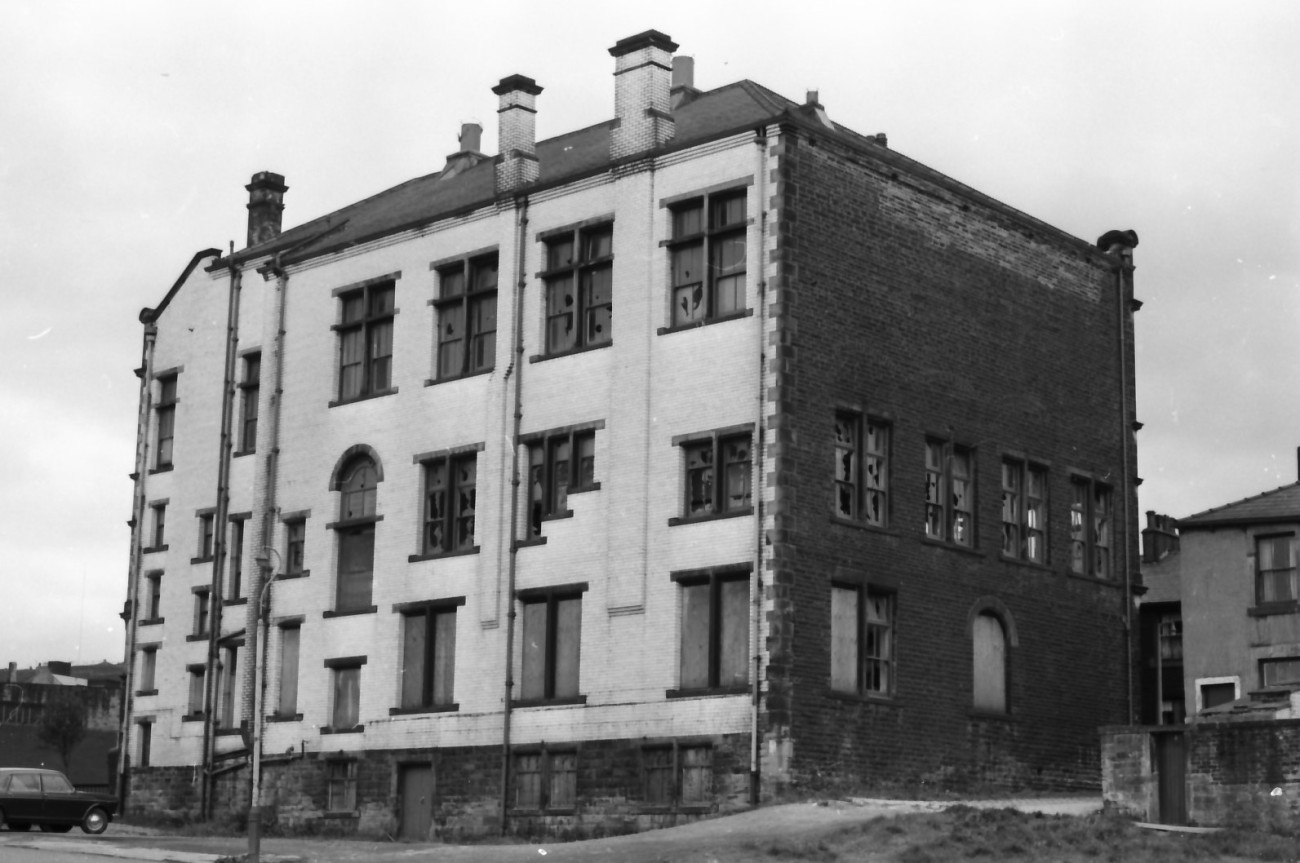


The back and other side of the building. A previously unpublished image.
From an article by Colin Lewis:
The 79-year-old Burnley Weavers' Institute is to be given new life, after lying empty and almost derelict for more than two years. This was revealed by a spokesman for the Manchester firm of valuers and surveyors, Meachin and Partners, who said that the building has been sold subject to contract. He said that the interior of the building is completely gutted, the roofs are stripped of lead, and we intend to rebuild the inside and install a new heating system. It had been suggested that the top floor could be made into a club, but this is only an idea at this stage. It was understood the buyer does not live in Burnley.
The institute was always a busy place. If it wasn't reverberating to the sound of an impassioned speech at a trade union meeting, it was echoing to the strains of the Charleston or some other favourite dance of the 20s and 30s. It won't be the first time the institute has been used as office premises. There are still many in Burnley who will remember making the journey up to Charlotte Street with their sickness benefit certificates when it was the home of the Local Department of Health and Social Security. It was only three years ago that the department moved out and into their new office block at Brunswick House. It was at that time, in 1972, when the Weavers' Institute met its greatest crisis. Burnley Weavers' Institute, now reduced to a much smaller operation, had been accommodated in their present St James's Street offices for 15 years. It was no longer feasible for them to remain owners of a massive building in Charlotte Street. Mr Bill Whittaker, the executive member of the association said they wanted the building to be taken up for public use but an offer to the local authority was rejected. Eventually the building was sold for around £10,500 to an outside buyer and since then the impressive building has become a target for vandals, lead thieves and stray cats.
Mr David Holmes, the champion of Burnley weavers and a founder of Burnley Weavers' Association was devoted to the weavers' movement, causing the institute to be built. For the cost of £2,000 it was completed in 1896 and opened on September 26th by the formidable Lady Dilke, an early woman trade unionist and suffragette. After the opening ceremony large crowds took tea and refreshments in the large assembly hall accompanied by a musical selection from Simpson and Thomson's band. A decade later the Burnley News reported that the institute was "daily a busy hive," and the home of no less than 30 different trade societies. As well as being an important meeting place during the hey day of trade union activity, the institute was a focal point in the social life of the town. Many a heart was won or lost on the dance floor of the "Weavers" during the interwar years, and there must be a good number of local folk whose visits to the "in-place" of the time ended in marriage.
Local artist David Wild has suggested that the institute would make a fine arts centre for Burnley - given the interest and support of the public.