Benedictine Casts Its Spell On An Army
29 Apr 1975
Keirby Hotel, Keirby Walk, Church Street, Burnley
Media Ref: BE75ng0763
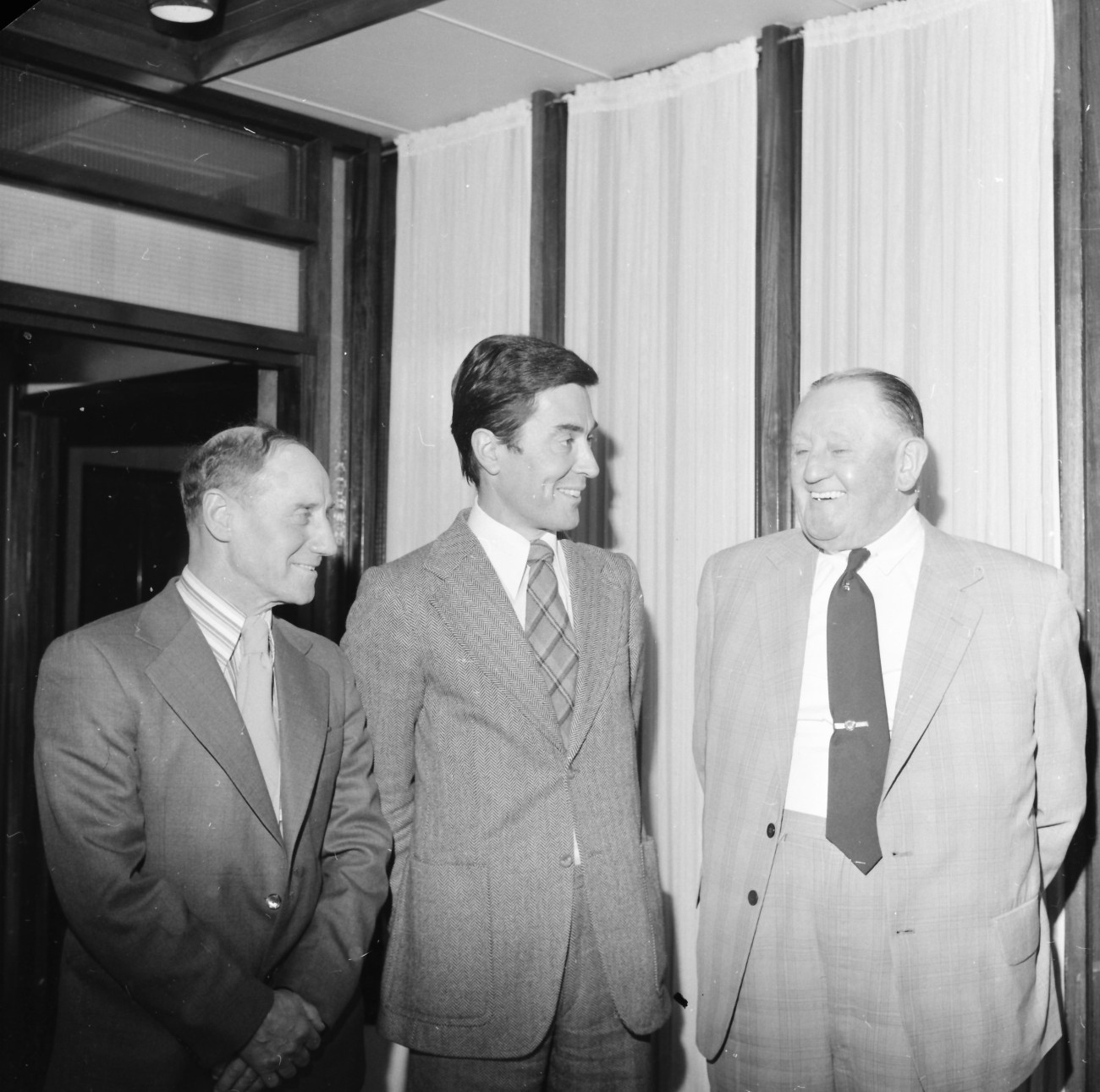
M. Le Grand (centre) with Mr E Hutchinson, chairman of the association, and Mr Bob Lord.
When the first world war drew to a close in 1918 men serving with the East Lancs Regiment were all glad to be able to return home to their families - but there was a slight delay in the case of men of the 11th battalion. They have since been dubbed "the lost regiment," but during the days immediately after the war nobody remembered to call them home, no one seemed to notice their absence. Not a wife, nor a mother, nor a sister reported her loved one missing. Meanwhile, across the Channel in Normandy the 11th battalion had found its Shangri-la. Stationed in the small village of Fecamp the men had discovered an elixir whose aroma held them spellbound. But in 1919 the War Office discovered its mistake. The spell was broken, and in June the men returned home. And so was forged the link between Burnley and Fecamp's famous Benedictine liqueur.
Today more Benedictine is drunk in Burnley than in any other part of the country, and on Tuesday evening, 29th April 1975, one member of the family which produce the liqueur presided at the annual banquet held by Burnley Licensed Victuallers' Association. M. Bruce Le Grand is the great-great grandson of the man who accidentally discovered the recipe for the elixir made by the old Benedictine monks of Fecamp, and gave Burnley one of its most popular drinks. Two of the men who discovered Benedictine in 1918 were present at the banquet, representing their comrades of the East Lancashire Regiment - Major A. J. Wallace and Captain R. W. Thorne. During his short stay in Burnley M. Le Grand was given a conducted tour of Turf Moor by chairman Mr Bob Lord, and was received by the Mayor and Mayoress of Burnley, Councillor and Mrs Edward Hanson, at the town hall.