Change Afoot Amid The Sea Of Chimneys
10th February 1976
Brooklands Road, Burnley Wood, Burnley
Media Ref: BE76ng3034_a
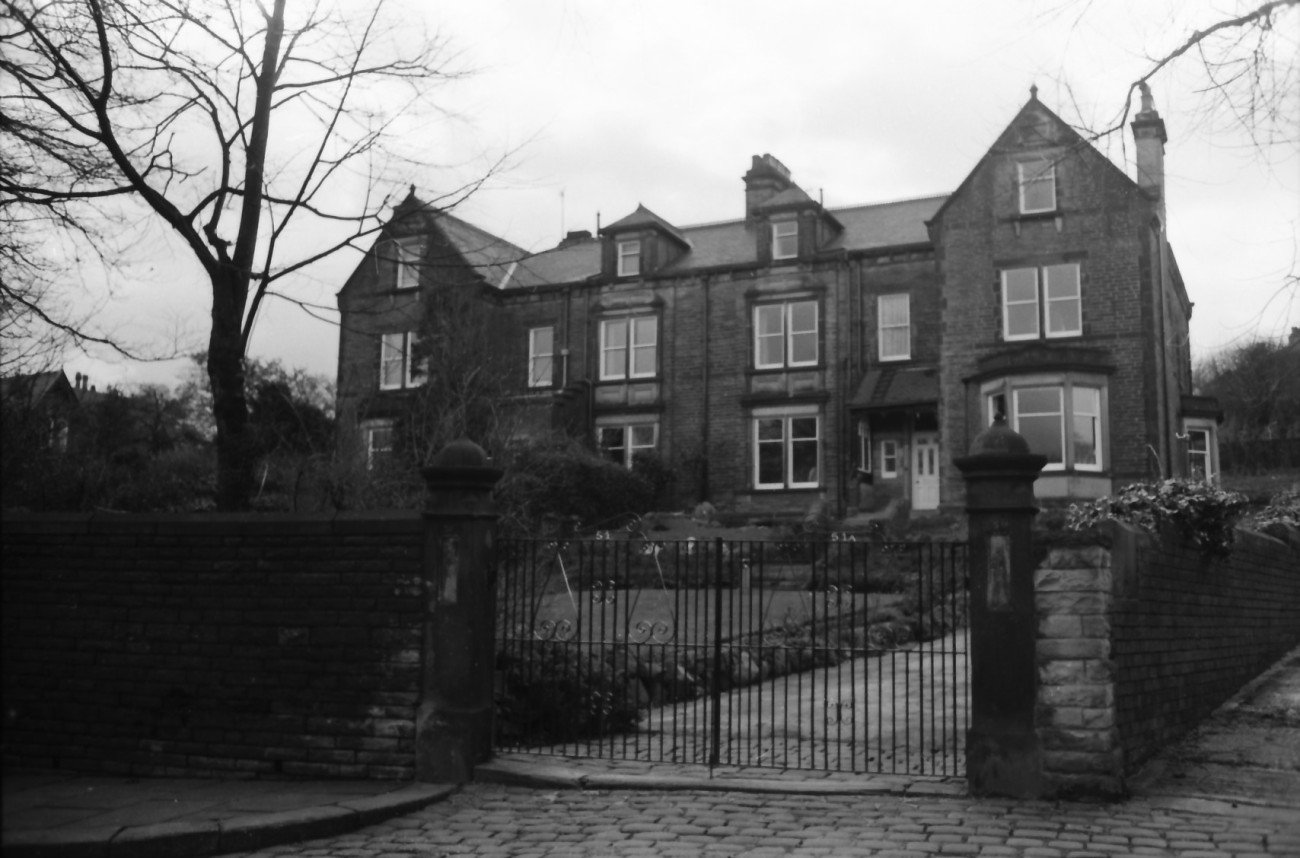
In 1876 Colonel Towneley submitted a plan for the construction of streets that would include Brooklands Road, Stoney Street and Kingsland Road, and the development of housing on Hufling Lane. Villas were built on Brooklands Road; the remaining streets contained terraced houses.
By Richard Catlow:
Two more Burnley Express "Best of Burnley" awards are revealed this week as civic trust members, town planner David Ellis, Padiham artist Duncan Armstrong and myself, continue our tour of the town, looking for the people and places huh are making Burnley a better place in which to live. Meanwhile the Burnley Express photographers and I have been taking a close look at the area of town between The Ridge and Healey Heights.
Burnley couple Trevor and Jacqueline Wooller have never got around to opening their stately home to the public. In fact, as Mrs Wooller admits, most people don't even know that their home - just about the most historic in the town - exists at all. For Hufling Hall, built in 1696 and outwardly little changed since that date, has never figured prominently in the pages of history books. It has remained tucked away in Burnley Wood keeping a low profile, as befits its age. But when the hall was built Burnley Wood really was a wood, and there were acres of green fields and countryside around the house. It was the Victorians who hemmed in Hufling Hall with ranks of terraced houses, until the great vistas from its windows shrunk to the width of a cobbled street, and its grounds became nothing more than a small apron of garden. The fortunes of the house had sunk to their lowest in 1959 when Mr and Mrs Wooller, then newly married, set up home there. “It was in a pretty bad condition. We had to put in a lot of hard work to make it suitable to live in,” said Mrs Wooller.
Now the hall combines the best of the new — central heating and all mod cons — with the best of the old — thick insulating walls, elegant mullion windows, and that indefinable quality, “character”.
The house has just been put up for sale and Mrs Wooller admits that leaving will be a heart-rending process. “We shall take a lot of memories from here. But I also believe that houses absorb some of the personality of the people who have lived in them, so we shall also be leaving our mark,” she said.
If the stones of Hufling Hall could tell stories as well as absorbing them, there would be little need to write this article. We could all just sit back and listen. For these stones have witnessed almost every act in the district’s history, though it wasn’t until last century that the plot began to quicken.
As late as 1872 the few people who did live in the area had to use stepping stones to cross the Calder at Oxford Road. In times of flood this could be dangerous and two people died during one spate. Eventually the town council responded by building a rickety wooden footbridge at a cost of £45. But it wasn’t really adequate and, in 1883, a proper bridge was built. This immediately opened up the area and soon 1,500 houses were built in the Hollingreave Road area, around the familiar chequerboard of streets. At the same time big areas of Fulledge and Healey Wood were being covered in terraced houses. The whole valley between Healey Heights and Ridge had become a sea of smoking chimneys.
A few larger buildings break the monotony of the criss-cross of terraced streets. Philanthropists built churches and chapels to cater for the working people’s spiritual needs, and the brewers built public houses to cater for their need of spirits. Both these buildings provided relief from the grinding hardship of work in the mills. St Mary’s RC Church, which has fine stone carvings and a magnificent west window, was built in 1849 at a cost of £10,000. St Catherine’s and St Stephen’s churches lie just a stone’s throw apart, but though St Stephen’s probably the better-designed of the two, St Catherine’s scores at the moment, thanks to its clean, new stonework. On a sunny day it positively glows with colour. Nearby the former Fulledge Methodist Church, which closed in 1959, is now owned by printers and stationers F. H. Brown Ltd, but still looks imposing with its great stone columns. Towneley Methodist Church and the Hollingreave United Reformed Church are also clean and attractive. Even more imposing is the Convent of Mercy. The pubs and clubs have also been doing their bit to improve the environment. The Woodman and the Rose and Thistle Club stand out from their smoke-blackened surroundings thanks to the sandblasters' art. But other changes in the area have gone more than skin deep. Huge areas of houses, many of which had degenerated into squalid slums, have been cleared, leaving great areas of mud and weeds: unofficial car parks and illicit rubbish dumps. There's also the more hidden pain of whole communities being torn apart.
Thankfully a new world is growing up on the doorsteps. New homes have been and are being built, which mean that people who have lived in the area all their lives need not face exile to Kibble Bank or Barclay Hills, far away from their friends and the town centre shops. The new council estate at Higher Tentre is a vast improvement on the old terraced houses. Curving avenues get away from the old chequerboard street pattern, and there is grass and trees — the first in Burnley Wood for many years — all very attractive. Less attractive are other new houses at Springfield Bank. Why these had to be coated in grim, grey-black pebble dash I can’t guess. Surely Burnley has enough black buildings already?
Other new buildings include the Temple Street Recreation Centre and the industrial estate at Healy Wood. The transformation has been almost as dramatic as the one which took place last century, and this time it's a change for the better. This environmental transformation has been matched by a transformation in people's views. From Victorian times until quite recently people thought nothing about living next door to factories. But in the last few years Burnley has heard increasing complaints from people in this position. One of the most publicised complaints was in Fulledge where neighbours of the Northern Diecasting works protested about the noise. Here is no doubt that people and factories don't mix so well nowadays, but it has to be remembered that in many cases the factories were there before the houses. On Plumbe Street the works of FMC Fellmongery Ltd carries out the age-old craft of treating animal hides, blowing the none-too-pleasant smell, and pieces of wool littering gardens as far away as Higher Tentre.
One piece of the industrial revolution that nobody minds is the canal. At their Finsley Gate depot British Waterways have recently renovated the old dockhouse and built new offices in matching style and materials. The depot yard looks clean and well-swept, and trees have been planted. With the brightly-painted boats moored in the little canal basin, it makes a perfect picture. But it isn't only public bodies or big companies that can change our environment for the better. The householders of Springfield Road, near where it crosses Hollingreave Road, have showed what can be down with just a few cans of stone paint. Nearby is Brooklands Road, with its big houses and even bigger gardens. On the other side of the (railway) tracks is the wooded retreat of Hollin Hill. where birds and humans find an ideal place to bring up families.
Further up the hill Moseley Road, not so long ago a country lane, is now hedged in by new houses. But on either side the countryside is returning at Towneleyside where the old colliery tip is being reclaimed by Lancashire County Council, and at Healey Heights where Burnley Council has planted hundreds of trees. Unfortunately some of the trees have been damaged by vandals, and vandalism is not new. Even in the 19th century newspapers complained that it was becoming unsafe to walk at the foot of the hill, because of youths who rolled boulders down it. Huddled in a fold of the ground nearby is the farmhouse of Lower Howorth Fold, which possesses one of the most beautiful items in all Burnley — an intricately carved datestone. In those days nearly every building had its datestone, coupled with the names or initials of the people who lived there. It is a practice that has virtually died out.
At the other side of the great valley that cradles Burnley rises the Ridge. The ranks of houses on the Brunshaw and Turf Moor estates look, from the distance, like a great cliff of grey pebble-dash.
Things are not so grey when you actually get there. For some reason, perhaps because the houses are on a south-facing slope, the gardens seem to be among the best in Burnley. Mrs Mary Cherry, of Sladburn Avenue, carried off the prize for the best council house garden in Burnley in last year’s competition organised by Burnley Horticultural Society. She hasn’t got the space that some gardeners have at their green fingers, so she has to make use of every available inch. In summer bedding plants, roses and a host of other colourful blooms are set against a background of cool green cypress saplings.
On the other side of Brunshaw Road stands one of Burnley’s finest buildings, The Hollins. Surrounded by trees and cleaned stonework glowing in the sun, it looks really magnificent. It was the home of Victorian critic and poet Philip Hammerton, and if he could see it now he would be proud of it. It’s a serene world, far removed from the hustle and bustle of the busy shopping area where Plumbe Street and Yorkshire Street meet. There you find the colour of the shop window displays, the sound of feet on pavement, and the aroma of fish and chips. The Catholic Repository, at the road junction, must be one of the most unusual buildings in the country. A sort of wooden shed, tacked on to the side of a shop, I doubt if I’ve seen a narrower building anywhere. On the other side of Yorkshire Street is Brickmakers Arms, a big rambling building, it must have kept plenty of brickmakers in work, manufacturing the bricks to build it.
One couldn’t leave the week’s “village”, however, without mentioning what must be one of the town’s major conservation triumphs. In 1971 the council decided to knock down the 300-year-old Towneley gatehouse, which was in poor condition and would cost too much to renovate. The gatehouse was little more than a grimy shell when it was bought by do-it-yourself man Mr Jeff Boothman. The building was without a roof or a ground floor ceiling, and the two large arched windows were bricked up. Now, with clean stone walls and extensive but tasteful modernisation, the gatehouse is one of the town’s most desirable residences.
It also, perhaps, indicates a common sense and a victory for the Burnley and District Civic Trust, which campaigned successfully against the demolition of the gatehouse. It also, perhaps, indicated a growing awareness of the need to save our architectural heritage.